KinnickinnickEXPLORATION INC.
Projects

Projects.

Explore our producing-well interests, past projects and proposed exploration opportunities.

Prospects.

Our prospect focus

Our October 2026 prospect position covers approximately 4,000 acres across two trends evaluated with 3D data, with dry-land locations outside wetlands. Our main partner is Hardy-Holdco / J. Hardy. Detailed discussions require a two-year confidentiality agreement.

Sold

Bogard prospect

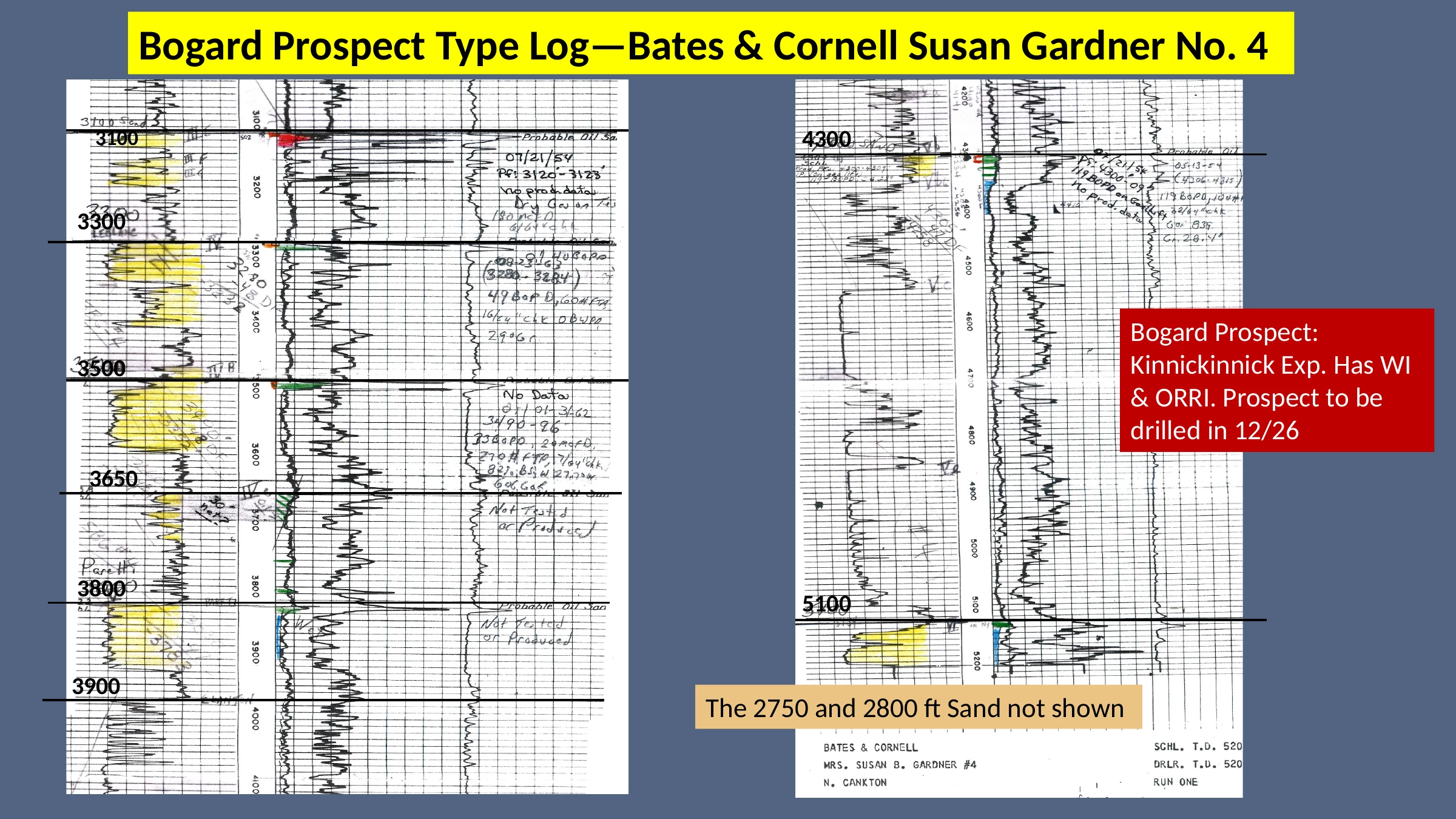
A sold shallow-oil prospect developed with industry partners near North Cankton.

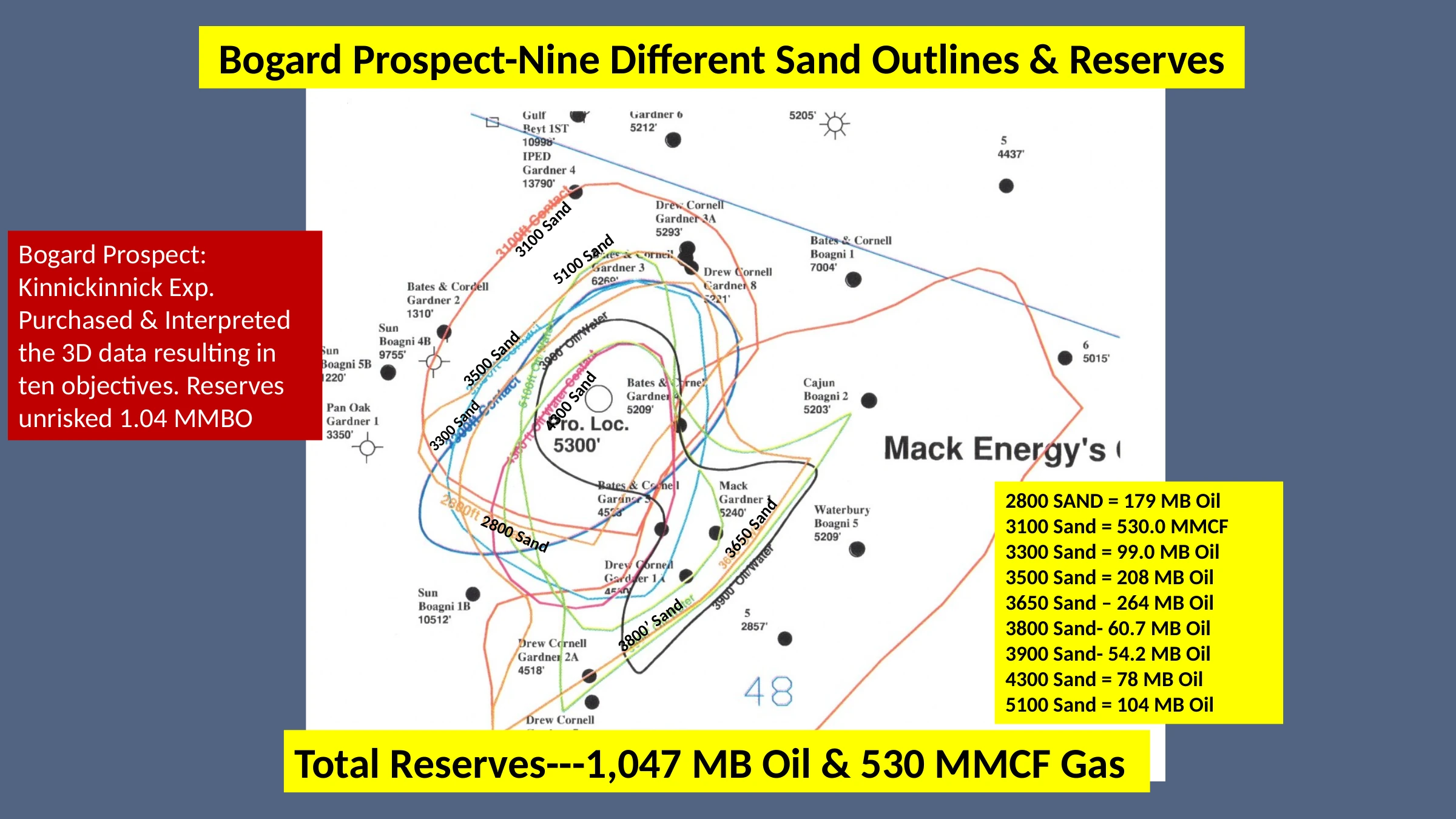
We developed and sold this shallow-oil prospect with Andy Vodicka and Jim Diehl. Reprocessed 3D data purchased from Seitel supports the interpretation of multiple sand objectives.

The type-log reference is Bates & Cornell Susan Gardner No. 4. The drilling plan names Forza Operations, LLC as participant and operator, with a proposed total depth of approximately 5,200 feet. We hold working-interest (WI) and overriding-royalty (ORRI) interests.

The unrisked prospect estimate is approximately 1.047 million barrels of oil and 530 million cubic feet of gas. These are exploration estimates, not production or proven reserves. The October 2026 drilling plan schedules the well for December 2026. Contact us to discuss the drilling schedule.

Although the project is moving forward to drill, there may be carried working interest for sale, or a partner may lay off an interest for the right price. Contact us to discuss availability.

Sand-by-sand prospect estimates

Sand depth (feet)Estimated oil (barrels)Estimated gas (MMCF)
2,800179,000—
3,100—530
3,30099,000—
3,500208,000—
3,650264,000—
3,80060,700—
3,90054,200—
4,30078,000—
5,100104,000—

Unrisked exploration estimates. MMCF means million cubic feet.
PROPOSED EXPLORATION · FOUR WELL CONCEPTS

Proposed exploration.

We are currently working on four deep drilling opportunities.

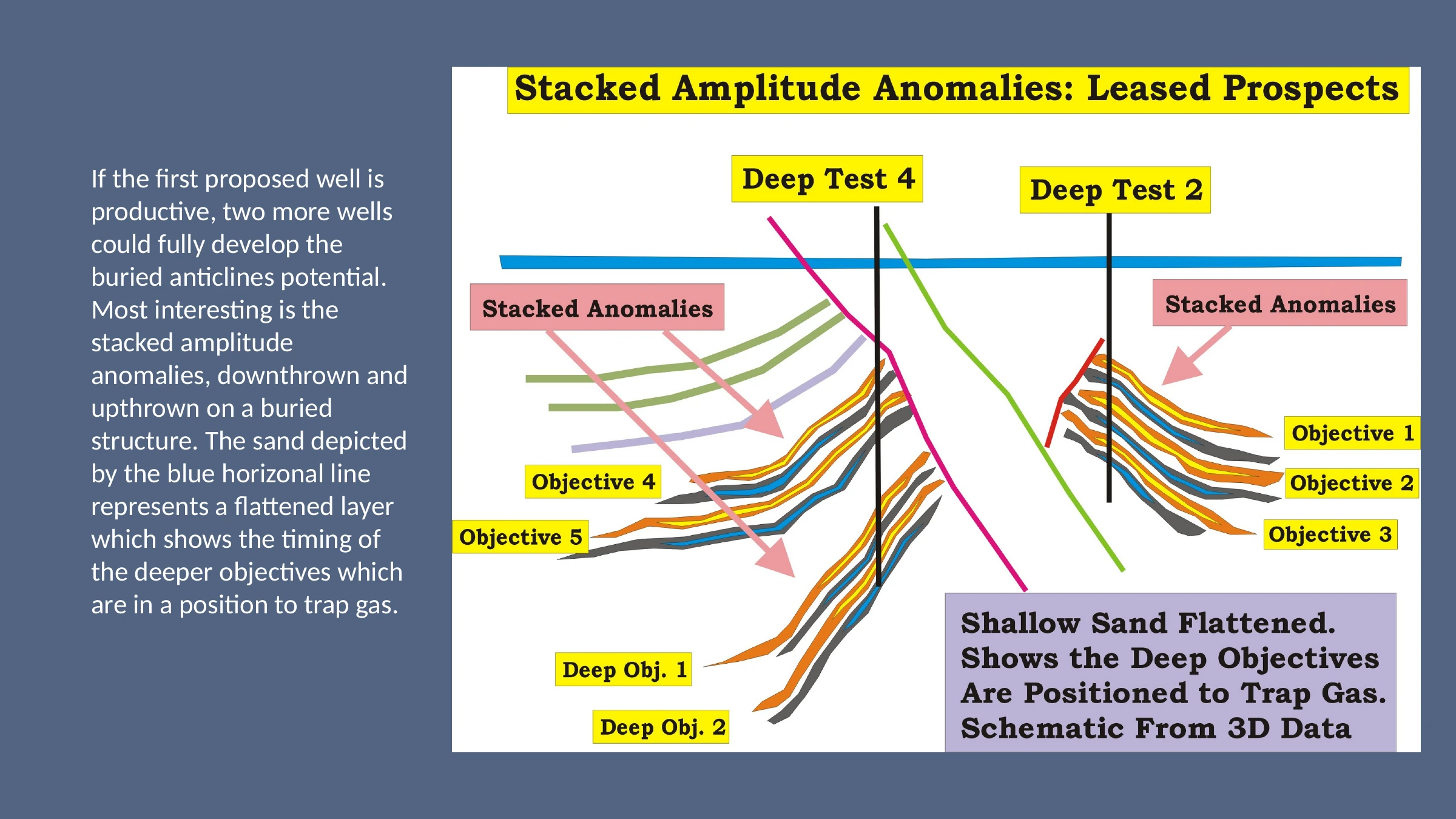
With new techniques applied to 3D seismic processing, an area that only had 2D seismic data before reveals several large reserve traps. The timing of the structure is the result of salt movement early, just after the deeper sands were deposited. In other words, the timing is perfect to find gas reserves with thick sands. We know the timing by flattening on the sand just above the deeper sand section, which reveals a thin area, meaning the deeper section was in a position to trap migrating hydrocarbons.

Can seismic imaging estimate and map the thickness of sand bodies? Majors and major independents have used advanced processing techniques and modelling to lower the risk of finding sands filled with gas and condensate reserves. Smaller innovating companies can now use the same technology. The one deep well in the prospect area confirms thick sands which match the seismic amplitude anomalies.

Proposed well concept 1

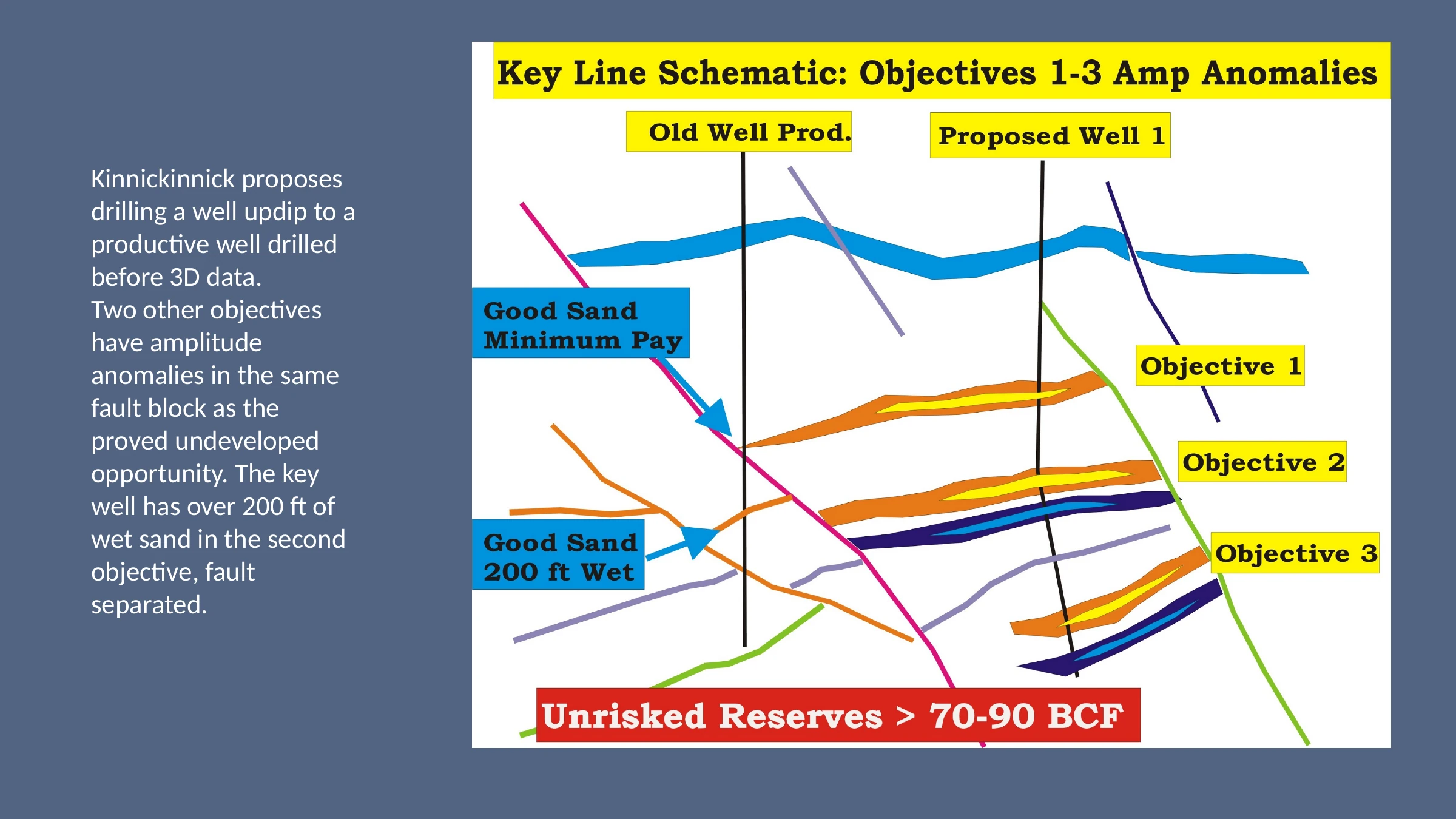
Three objectives, including updip from a productive well

A proposed 17,700 ft well tests an amplitude updip from an older productive well and tests two deeper sand objectives with apparently thicker amplitude anomalies.

With 3D seismic shot 35 years later, the productive well barely hits the reservoir and an updip amplitude anomaly could yield 27 BCF. Furthermore, two other sands could be tested deeper with the same well, bringing possible reserves to 98 BCF and 490 MBC.

Proposed well concept 2

A sand wedge at a Failed Shelf Edge

A proposed 18,500 ft well tests three amplitude anomalies stacked on a downthrown closure of a Failed Shelf Edge.

The anomalies have Class 3 trough-peak reflections. After modelling the response, the sand thickness is estimated to be 200 ft. With a 20 Hz Ricker wavelet derived from the 3D data, tuning is determined to be 100 ft thick. The proposed well would test all three amplitude anomalies.

Using an average sand thickness of 100 ft, these prospective reservoirs would hold an unrisked 508 BCF and 2.5 MMBC. The first objective apparently has a downdip gas/water contact that fits the contour and is flat across 8–10 dip lines.

Proposed well concept 3

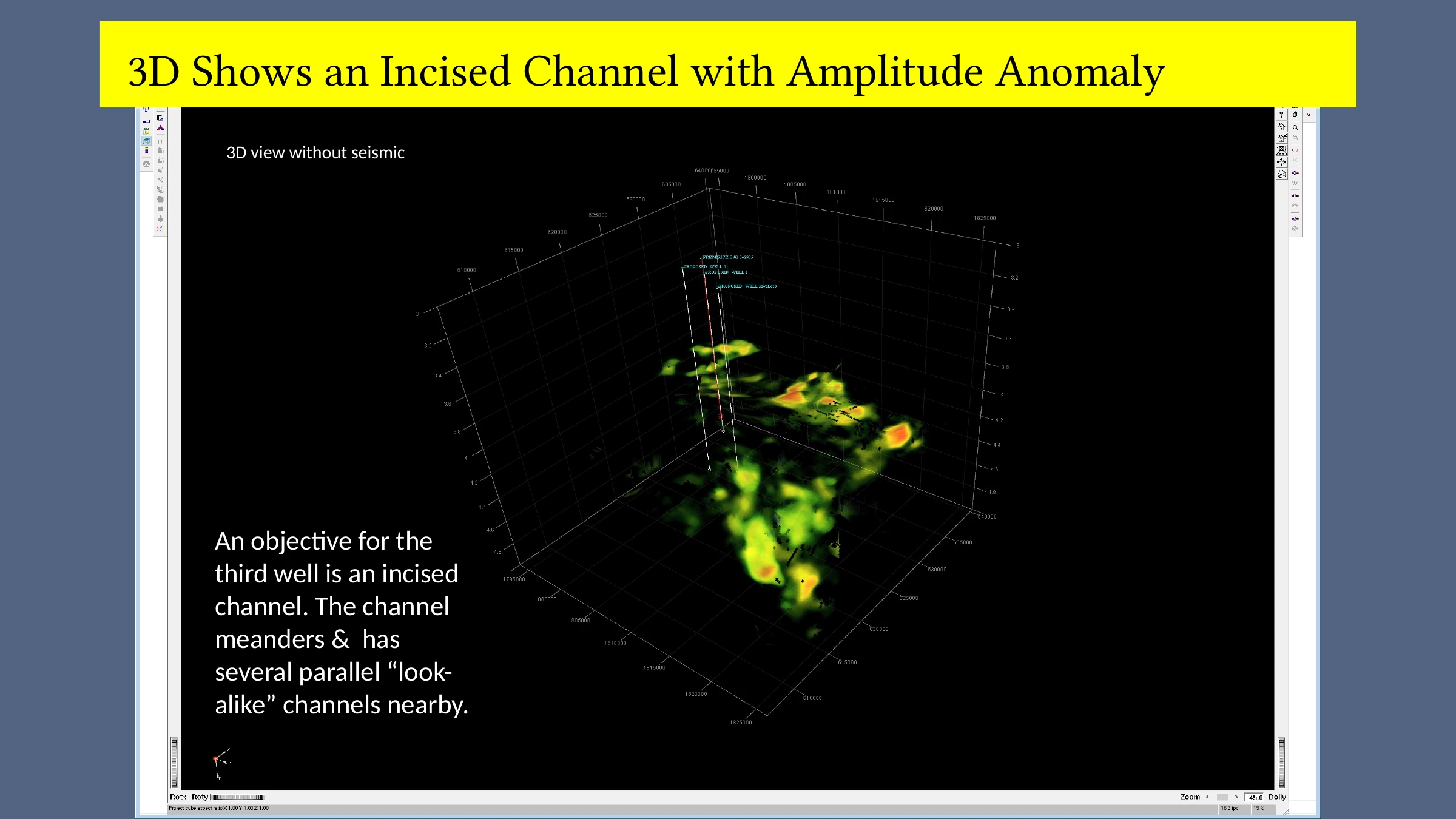
An incised channel

A proposed 18,200 ft well tests an incised channel interpreted as the sand source for sands deposited farther south on the Failed Shelf Edge.

The analogy for the Failed Shelf Edge is Eastbay Field, initially discovered by Shell and sold to Flores & Rucks in 1992. As the first geophysicist hired by Flores & Rucks, Steven Anderson learned the field in detail.

The incised channel prospect has a trough-peak anomaly that meanders over 1,100 acres across the 3D. A similar channel will be tested shallower in the section with the proposed 18,200 ft well. Unrisked reserves are estimated to be 209 BCF and 1.04 MMBC.

Proposed well concept 4

An upthrown sand wedge

A proposed 19,700 ft well tests a sand wedge on the upthrown side of a major down-to-the-south fault.

This prospect, with two possible offsets, is reminiscent of Garden City Field, which Steven Anderson worked on while employed by Quintana Petroleum. The 2 TCF Garden City Field was a north-dipping three-way closure that produced the Marg. A Sands.

There is an anomalous flat event at the termination of the sand wedge which seems possibly a gas/water contact. A 19,700 ft well would be required to test the first of several traps with a combined unrisked gas estimate of 1.05 TCF and 5.24 MMBC.

New Projects.

Leased prospect

No-pipe develocat

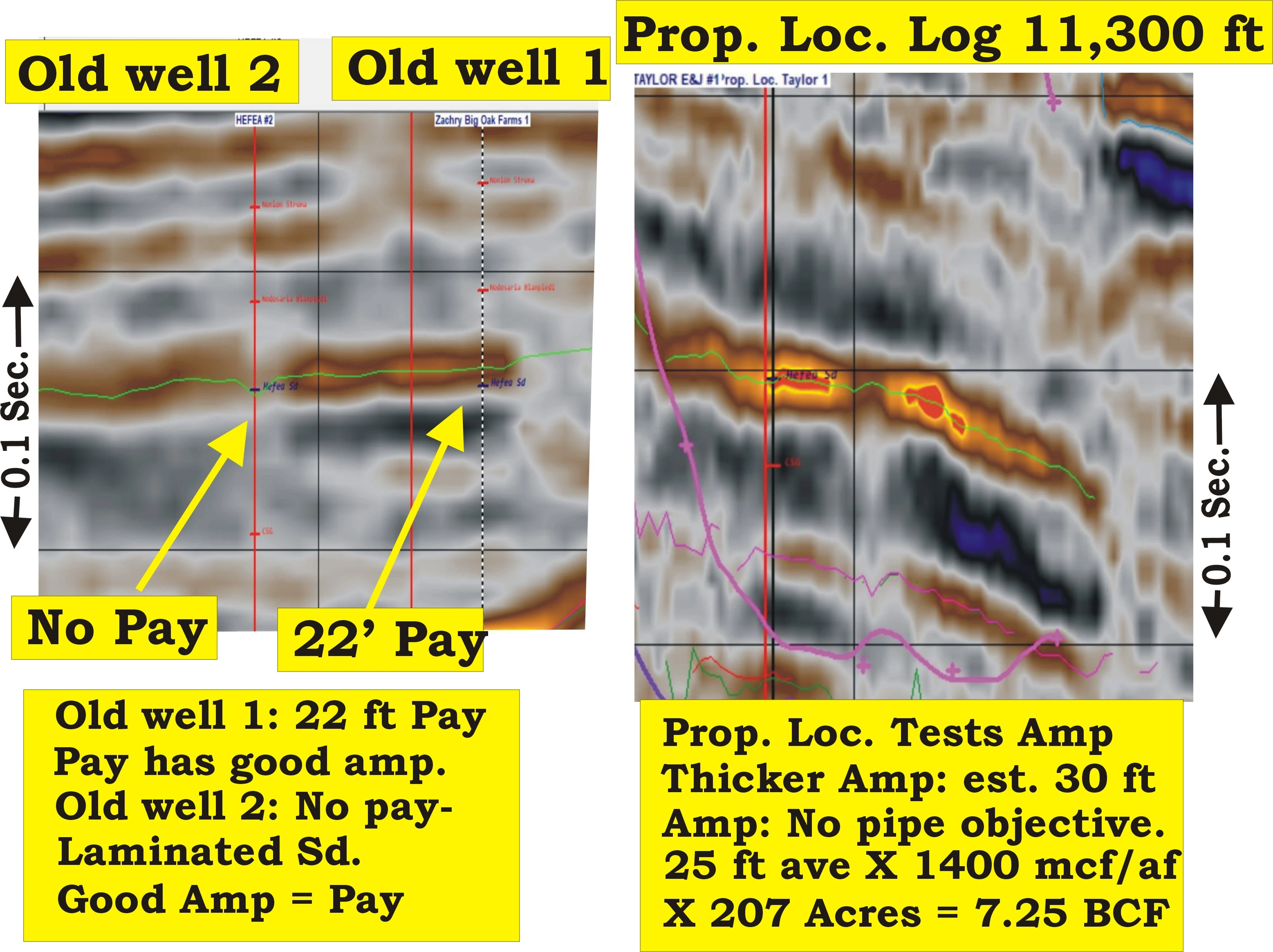
Kinnickinnick plans to market a leased “no-pipe” develocat prospect. A develocat is defined as a shallow well drilled to the first objective without expensive pipe. If the well has enough commercial pay in the first objective to cover the additional drilling and expense of running 7 5/8 pipe, then the well will be drilled to the deeper objective with investors assured of a return. The first phase proposes a vertical well targeting a sand above the geopressured section. After setting surface pipe at 1,200 ft, the well would be drilled to 11,300 ft and electrically logged. If the well encounters commercial gas and condensate pay, pipe would be set to produce it. Un-risked reserves are 7.2 BCF and 79.6 MBC. Once the shallow pay is covered and protected by the 7 5/8 in pipe, the well can deepened if the partners are in agreement.

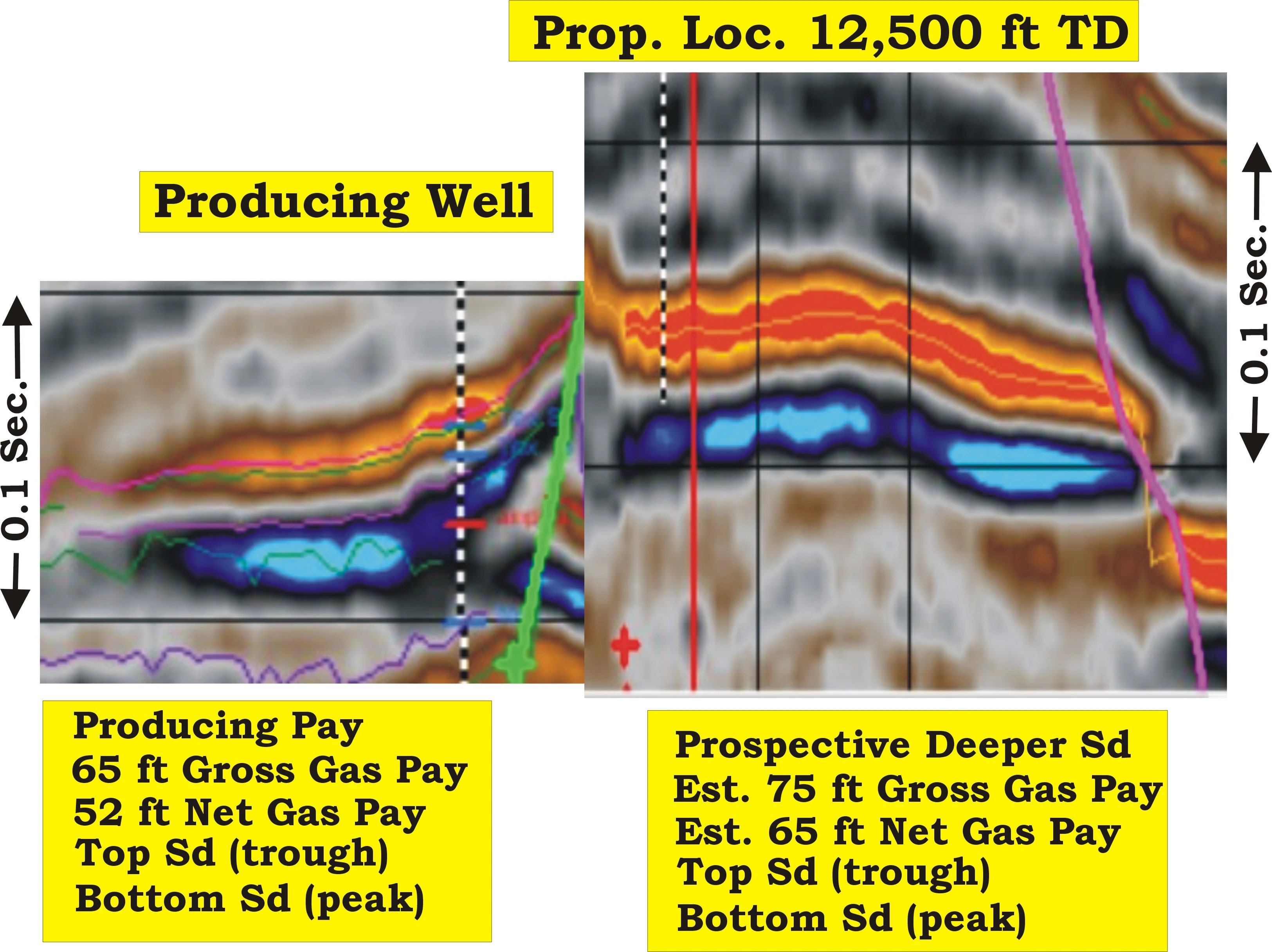
The deeper objective is mapped at 12,150 ft and tests un-risked reserves of 34 BCF and 680 MBC. To produce the deeper objective, 5 5/8 in casing would be run into the borehole if the well encounters more commercial reserves.

Adjacent wells show a higher condensate-to-gas ratio in the deeper section. Both objectives have amplitude anomalies correlated to existing pay.

Producing wells.

Well status as of October 2026. Production figures are cumulative unless identified as well-test rates.

Producing · October 2026

Arnaudville

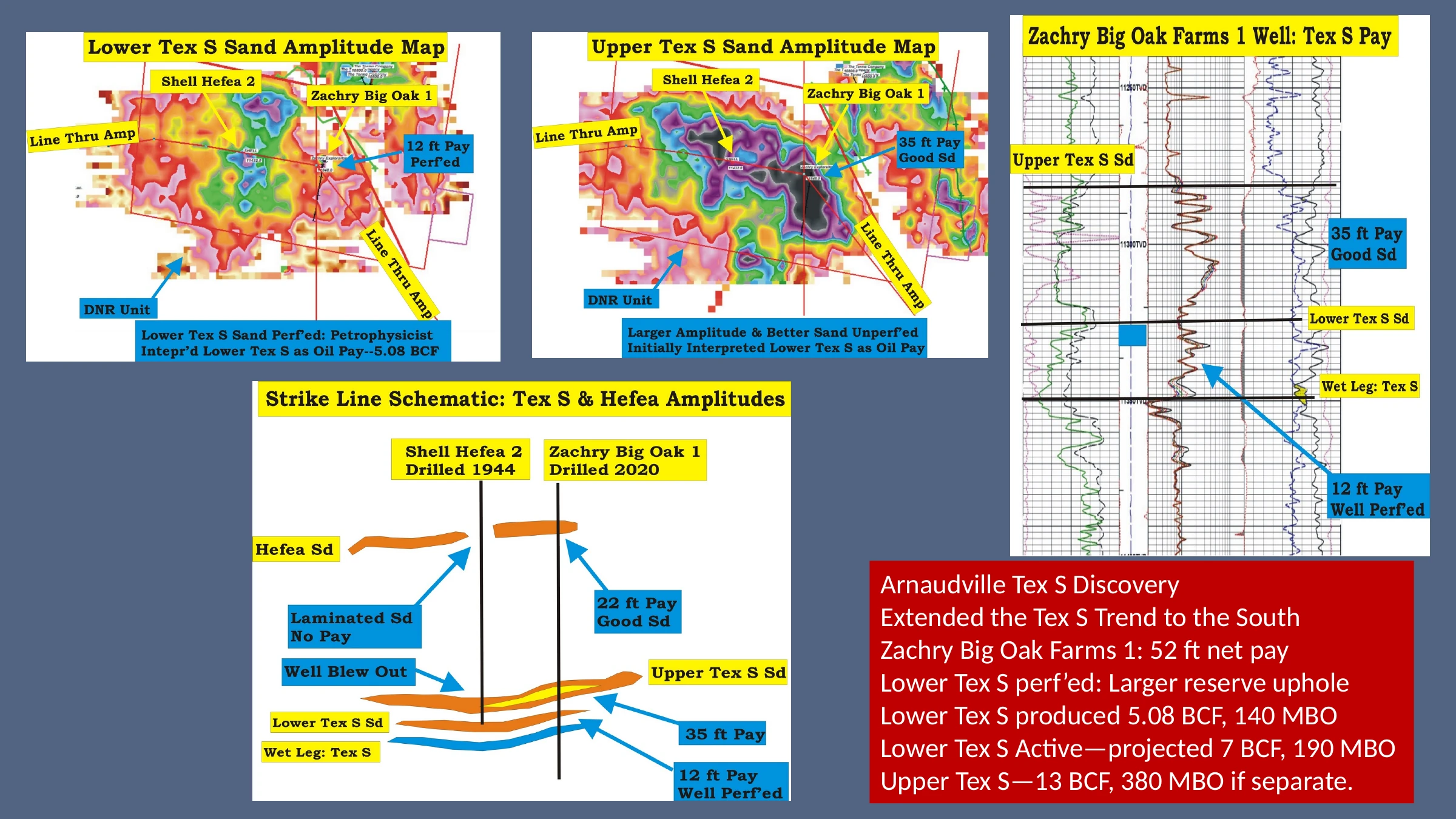
Two existing gas wells producing from the geopressured Tex S and Hefea Sands. Similar prospects nearby are being developed for presentation to investors.

The producing Zachry Big Oak Farms No. 1 well is producing the Lower Tex S, with 5.08 BCF and 140 MBC cumulated so far and an estimated 7 BCF ultimate recovery.

The Upper Tex S is separated by a 20 ft shale break. If this shale break prevents reserves from leaking into the lower interval, 13 BCF and 380 MBC may be produced once the well is recompleted uphole.

The two productive Arnaudville wells have Termo and Auterra as partners in the Big Oak Farms well and Termo/Petrogulf/Auterra in the Hebert No. 3 well. Termo Hebert No. 3 produces from the Hefea sand. Several potential prospects in these sands are currently being leased.

Producing · October 2026

Section 28 joint venture

A field partnership with The Termo Company, including the producing wells described below.

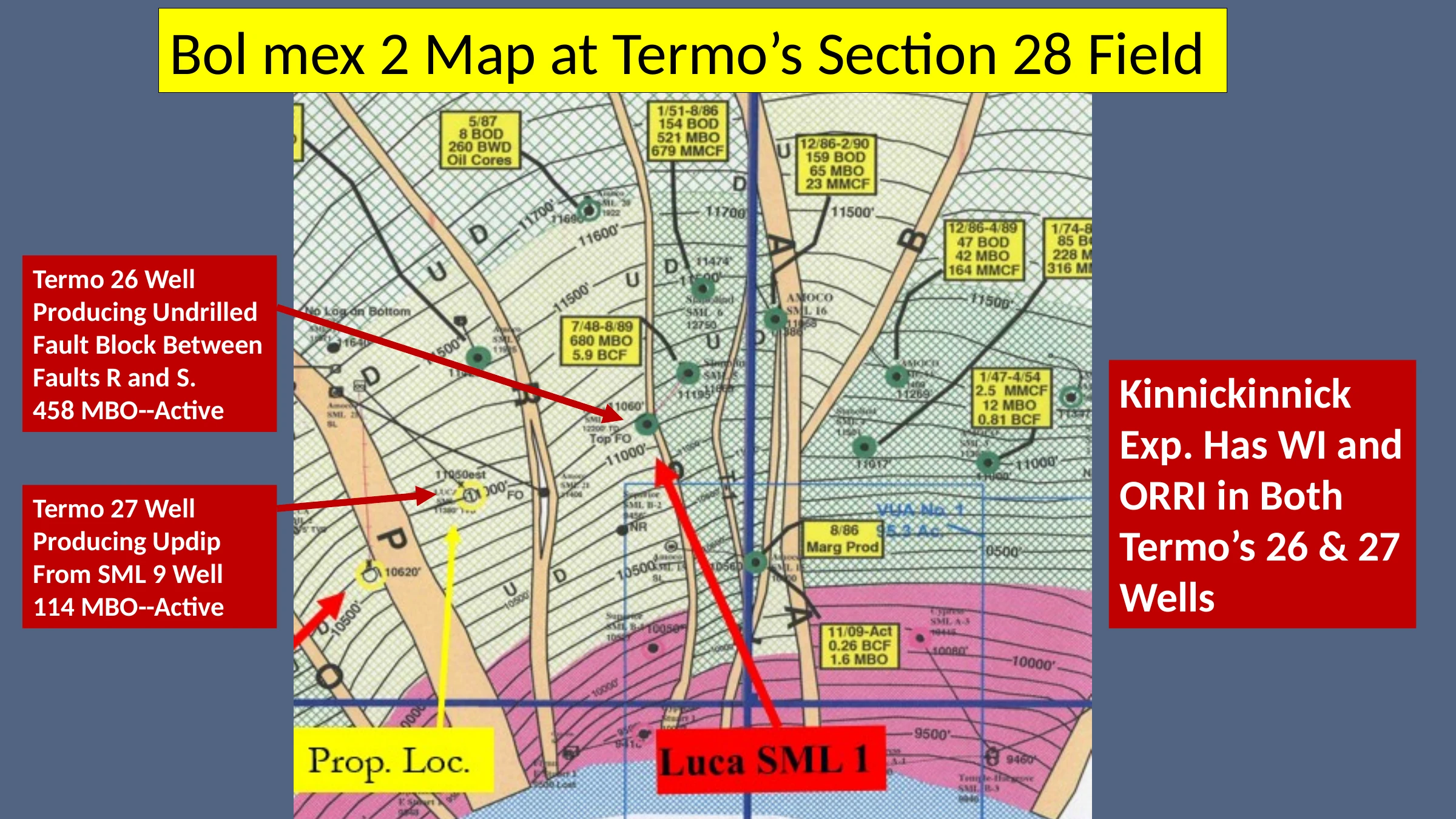
The Termo Company acquired both the Amoco and Chevron portions of Section 28 oil field in St. Martin Parish, Louisiana, in the late 1980s. Since it was Termo’s only field in Louisiana, Termo hired Kinnickinnick along with Jim Diehl and Andy Vodicka to further develop the field. As of October 2026, ten wells had been drilled, with four active oil wells, two dry holes and four wells no longer producing. Kinnickinnick supervised the data processing and participated in the geological and geophysical interpretation.

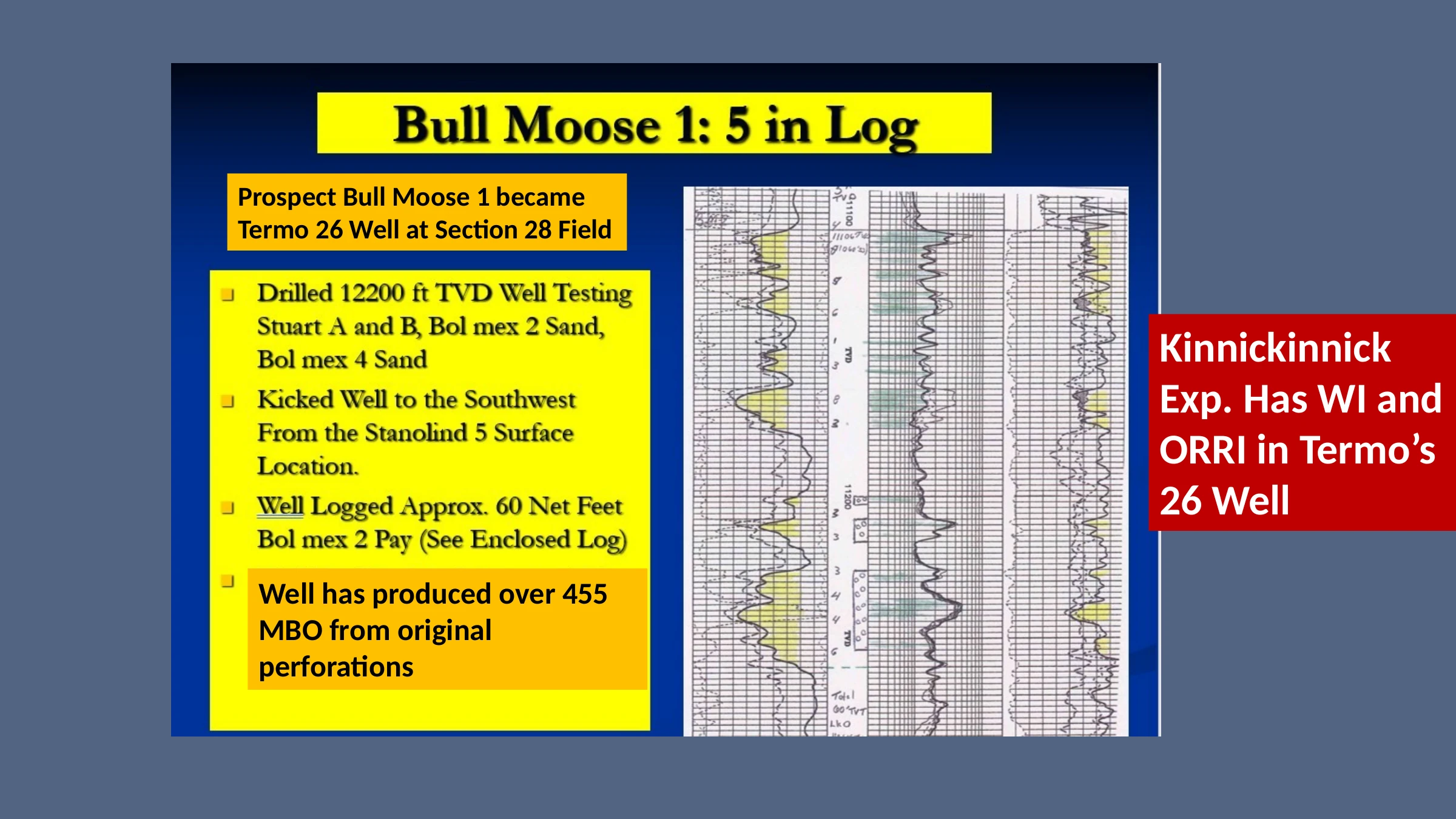
The Termo Nos. 26 and 27 produce from the Bol Mex 2 sand. We hold working-interest (WI) and overriding-royalty (ORRI) interests in both wells.

  • Termo No. 26 / Bull Moose: 458,000 barrels of historical oil production from original Bol Mex 2 perforations; active as of October 2026.
  • Termo No. 27: 114,000 barrels of historical oil production; active as of October 2026.
Producing · October 2026

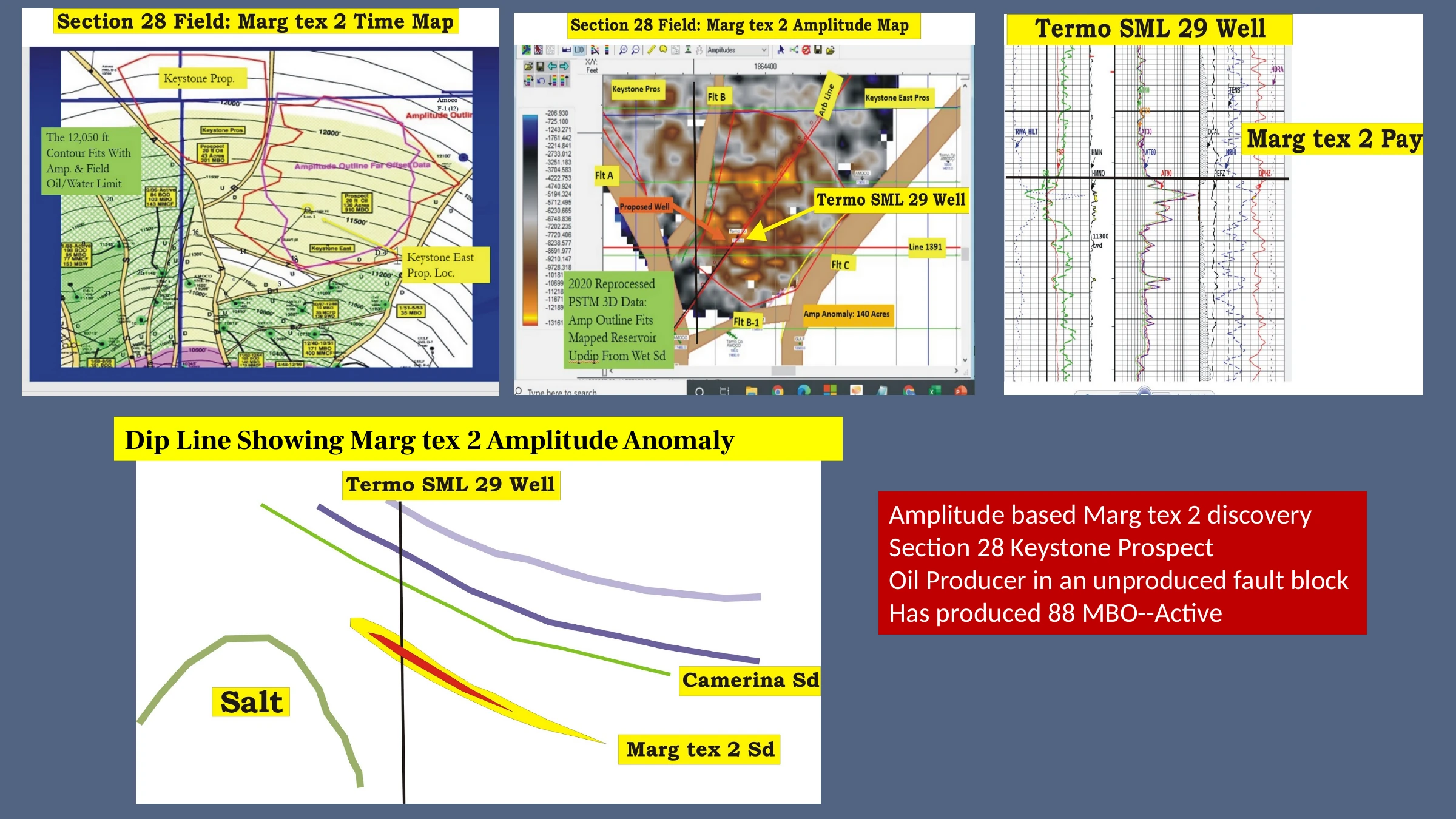
Keystone / Termo No. 29

An oil discovery in a previously unproduced part of Section 28.

An amplitude-based Marg Tex 2 discovery in a previously unproduced fault block. The well had produced 88,000 barrels of oil and was active as of October 2026.

Past work · company projects

Past work.

Historical company project

Andrew Field

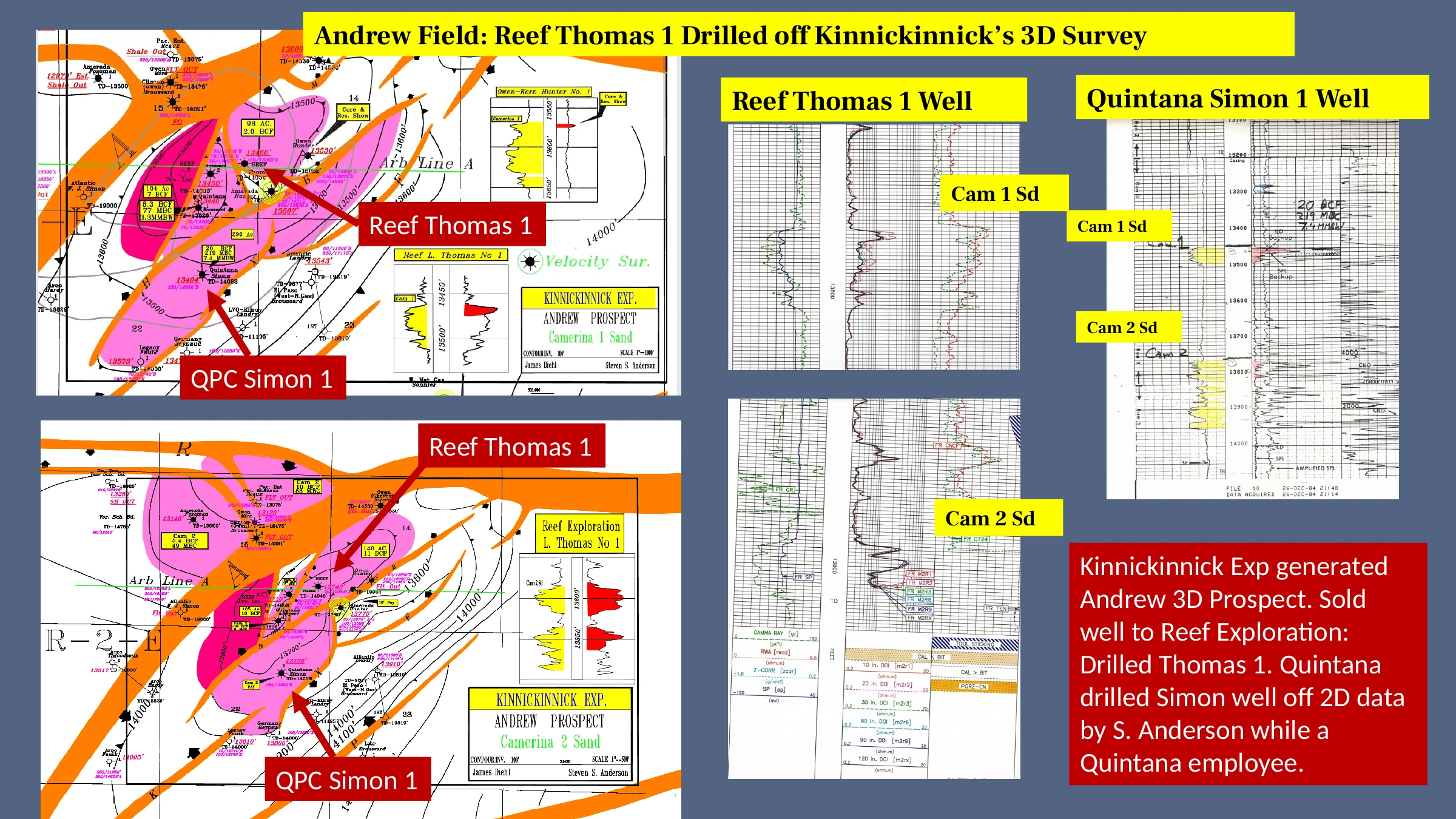
A company-generated prospect supported by a new 3D seismic survey and subsequently drilled by Reef Exploration.

Kinnickinnick initiated a 3D seismic survey and generated the prospect subsequently drilled by Reef Exploration as the Thomas No. 1.

This company work followed Steven Anderson’s earlier 2D interpretation while employed by Quintana Petroleum. His identification of an antithetical fault supported the Anne May Simon No. 1 and established production on the upthrown side. The later Kinnickinnick 3D project and earlier Quintana work are distinct parts of the field’s history.

Historical company project

Riceville · Broussard–Hoffpauir No. 1

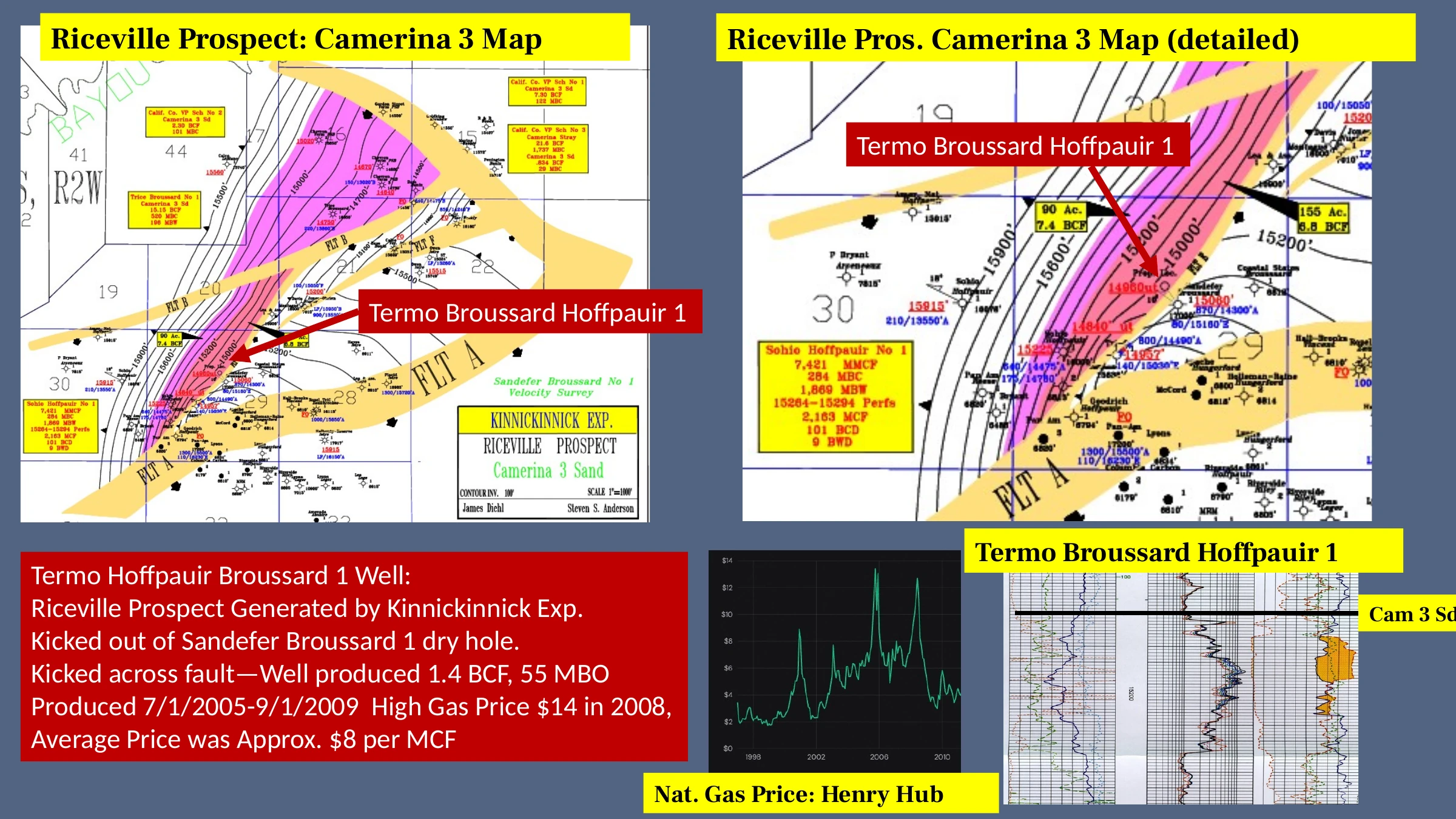
A Kinnickinnick-generated prospect drilled by Termo to reach updip “attic” reserves across a small fault.

Kinnickinnick generated the prospect to kick out of the existing Sandefer Broussard No. 1 well across a small fault. The well drilled by Termo found updip “attic” reserves from the productive Sohio Hoffpauir No. 1 well.

The Termo No. 1 well produced 1.4 BCF and 55 MBC. The well was drilled in a high gas price environment and, in December 2008, sold gas at $14 per MCF.

Historical company project

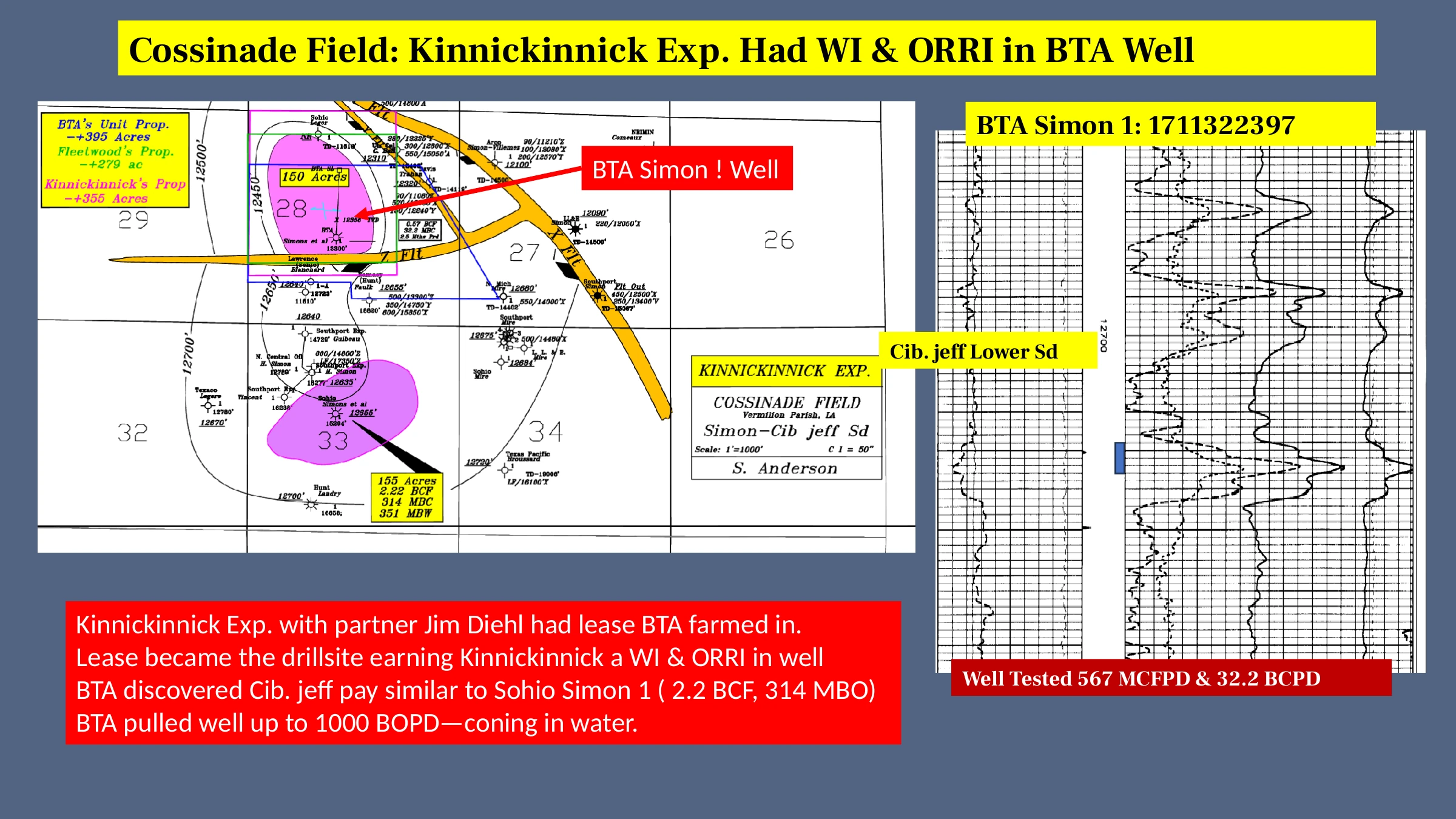
Cossinade · BTA Simon No. 1

A leased prospect developed with Jim Diehl and drilled through a BTA/Catapult farm-in.

Kinnickinnick and Jim Diehl held acreage that became the drillsite through a BTA/Catapult farm-in. Kinnickinnick earned working-interest (WI) and overriding-royalty (ORRI) interests through the farm-in.

The well initially tested at 567 MCFPD and 32.2 BCPD. The nearby Sohio Simon No. 1, an offset, produced 2.2 BCF of gas and 314 MC of liquids. The BTA well experienced water coning during production after the operator pulled the well too hard.

Earlier industry experience.

Explore the founder’s work before Kinnickinnick, including Eastbay discoveries, seismic surveys and Louisiana exploration.

View the founder’s project history →

Industry partners.

Meet the partners involved in our current prospects.

View industry partners →

Exploration estimates are unrisked and do not establish proven reserves or guarantee results. BCF = billion cubic feet of gas; MCF = thousand cubic feet. Historical production, test rates and projections are separate measures. MBO = thousand barrels of oil; MBC = thousand barrels of condensate; MMBC = million barrels of condensate.

Discuss a project.

Contact us to discuss a project.

Get in touch ↗